
How to Choose the Right SME Loan Consultant in Malaysia

Getting a business loan approved isn't just about whether your company qualifies — it's about whether you've applied to the right lender, with the right documents, framed the right way. Two businesses with near-identical financials can get very different outcomes purely based on which bank they approached and how the application was put together.
If you've decided working with an SME loan consultant makes sense for your business, the next step is knowing what actually separates a consultant who improves your odds from one who's just forwarding paperwork to whichever bank picks up first.
What a Good SME Loan Consultant Should Actually Be Doing
Before anything gets submitted, a consultant worth their fee should be doing real groundwork:
Reviewing your business model and financials well enough to know which loan type actually fits — working capital, equipment financing, or expansion funding aren't interchangeable
Checking your CTOS/Experian report and business credit profile, not just your bank statements
Matching you to banks that are known to support your industry and business size, rather than applying to whichever bank is most convenient
Helping prepare or tighten your business plan and supporting documents if the application needs it
Liaising directly with bankers during the process, not disappearing after submission
If the first suggestion is "let's just apply and see," that's usually a sign the consultant hasn't actually assessed your business yet — and for SME loans specifically, that's a costly shortcut, since approval timelines are already longer than personal or mortgage loans.
Questions Worth Asking Before You Commit
"Which loan type would you recommend for my situation, and why?"
A consultant who understands your business should be able to explain — clearly — why working capital financing fits better than, say, equipment financing, or vice versa. A vague "we'll figure it out" answer isn't a good sign this early."Which banks would you shortlist for a business like mine?"
Lending appetite varies a lot by industry and company size. If a consultant can't explain why certain banks fit your business specifically, they likely haven't done the matching work yet."What's likely to be scrutinised in my application?"
A consultant with real experience can usually flag likely sticking points early — inconsistent cash flow, a short operating history, an incomplete company profile — before an underwriter flags them instead."How long has my business needed to be registered, and does mine qualify?"
Most business loans require SSM registration for at least a year. This should come up in the first conversation, not after weeks of back-and-forth."How are you compensated?"
Legitimate SME loan advisory services are typically paid by the bank upon successful approval and disbursement — meaning your consultation should be free. Be cautious of anyone asking for payment upfront before any real review of your business.
Red Flags Worth Watching For
No questions about your business model.
If a consultant jumps straight to paperwork without understanding what your business actually does or how it earns, the loan match likely won't be well thought out.One loan type recommended for everyone.
Working capital, equipment financing, and expansion funding solve different problems — a consultant defaulting to the same recommendation regardless of your situation is optimising for ease, not fit.Vague timelines.
Business loan approval genuinely takes longer than personal loans or mortgages, but a consultant should still be able to give you a realistic range based on your documents, not just "it depends."Evasive answers about fees.
This should be one of the clearest, most immediate answers you get.
Consultant vs. Applying Direct: When It Actually Matters
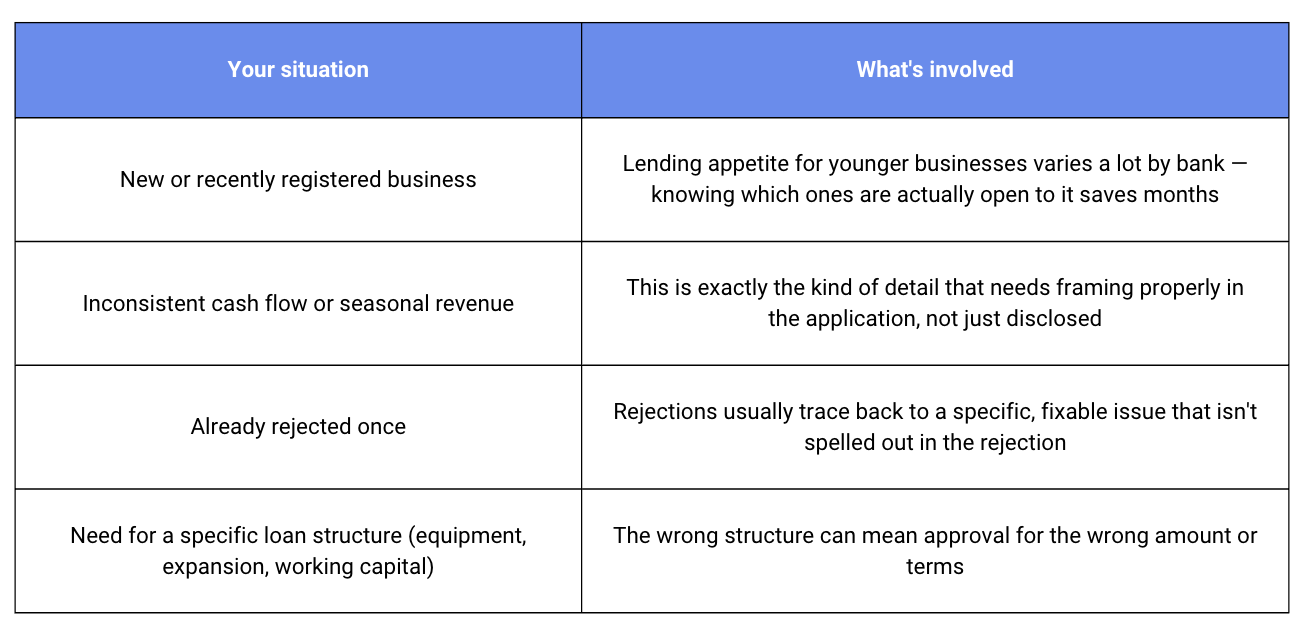
If your business has a strong, straightforward financial history and you already know which bank you want, applying directly can work — a consultant mainly saves time in that case.
Where a consultant tends to change the outcome:
What the Process Usually Looks Like
Business and financial review — understanding your business model, cash flow, and financing need
Credit check — CTOS/Experian and business credit profile
Bank matching — based on your industry, business size, and financing type
Document preparation — company registration, financial statements, and business plan if needed
Application and liaison — submission followed by ongoing communication with the bank until a decision is reached
Since SME loan approvals typically take longer than personal or mortgage loans, having documents prepared properly from the start is one of the biggest factors in keeping the timeline as short as possible.
Frequently Asked Questions
-
Business loan applications involve more documentation — company registration, financial statements, sometimes a business plan — and lending decisions weigh factors like industry and operating history alongside the numbers. A good SME consultant needs to understand your business model, not just your credit report.
-
Most business loans require SSM registration for at least one year, though specific requirements vary by bank and loan type.
-
No legitimate consultant can guarantee approval — no one can override how your business's financials are assessed. What a good one does is match you to banks realistically likely to say yes and help resolve issues before they become rejections.
-
Business loans generally take longer to approve than personal loans or mortgages, largely due to the volume of documentation involved. Having everything prepared properly upfront is the main lever for keeping this timeline reasonable.
If you're weighing up your financing options, FinPilot's SME loan consultants offer a free consultation to review your business and match you with the right financing — no commitment required.
