
How to Choose the Right Debt Consolidation Advisor in Malaysia

Consolidating your debts sounds simple on paper — combine multiple payments into one. In practice, the advisor you choose determines whether you end up with a genuinely lower monthly commitment and interest rate, or a new loan that just moves the problem around without fixing it.
If you've already decided consolidation is the right move, here's what separates a debt consolidation advisor who actually improves your situation from one who's just processing an application.
What a Good Debt Consolidation Advisor Should Actually Be Doing
Before recommending anything, a proper advisor should be doing real work on your file:
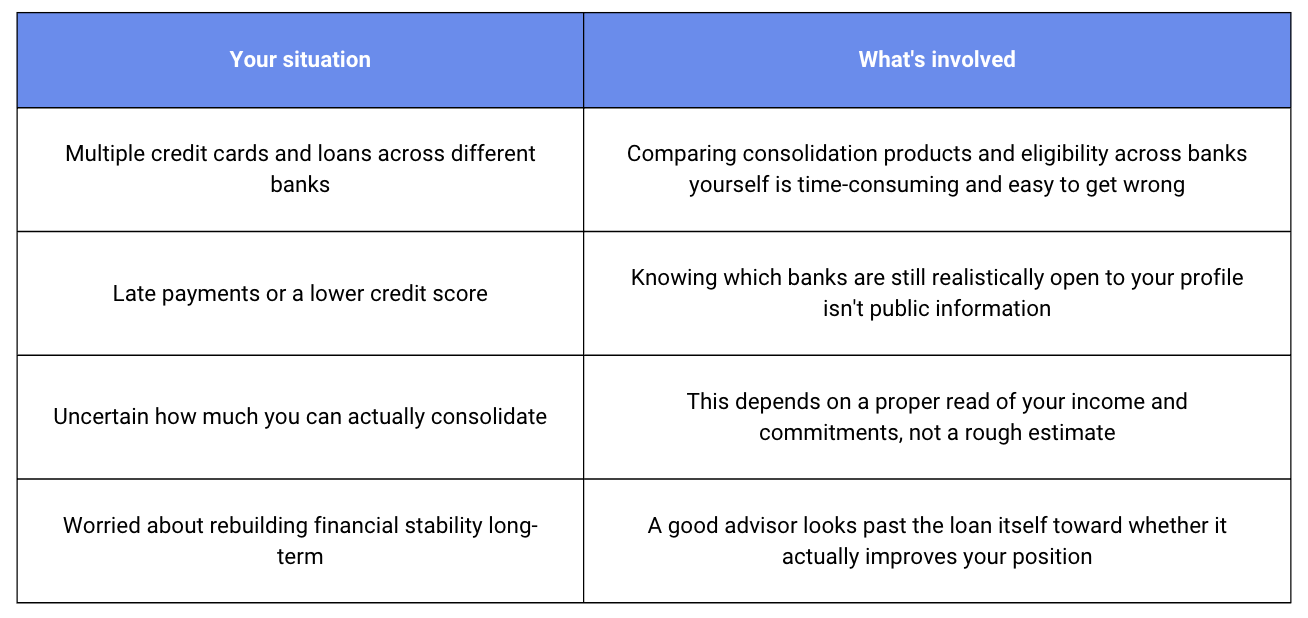
Reviewing your full CTOS/Experian report to understand exactly what you're carrying, not just what you've listed
Calculating how much you can realistically consolidate based on your income and existing commitments
Identifying which banks are actually open to your specific profile — this varies a lot depending on your commitment level and credit history
Comparing consolidation loan products for the lowest achievable interest rate and terms that fit your situation, not just the first offer available
Being upfront about whether consolidation will genuinely leave you better off, not just simpler on paper
If the conversation skips straight to "let's get you one loan to cover everything" without reviewing your actual numbers first, that's a sign the recommendation isn't built on your specific situation.
Questions Worth Asking Before You Commit
"Based on my current commitments, how much can I realistically consolidate?"
This requires an actual review of your credit report and income — not a guess. If an advisor gives you a number without having looked at your CTOS or Experian report, treat it as provisional at best.
"Which banks would actually consider my profile, and why?"
Openness to consolidation applicants varies a lot by bank, especially if you have late payments or a higher number of existing commitments. A specific answer here is a good sign the advisor has actually assessed your file.
"Will this actually lower my interest rate, or just my monthly payment?"
These aren't the same thing. A longer tenure can lower your monthly payment while increasing what you pay in total interest — a good advisor should walk you through this trade-off explicitly, not gloss over it.
"What happens if I have late payments or I'm currently blacklisted?"
This should be discussed honestly early on. Depending on your income level, there may still be workable options — but you want a straight answer, not one that avoids the topic.
"How are you compensated?"
Reputable debt consolidation advisors are typically paid by the bank upon successful loan disbursement, meaning your consultation should be free. Be cautious of anyone asking for upfront payment before reviewing your actual situation.
Red Flags Worth Watching For
No credit report review before a recommendation.
Consolidation advice without seeing your CTOS or Experian report first is a guess, not a plan.Focus only on "one monthly payment" without discussing total interest.
A lower monthly payment stretched over a longer tenure can cost more overall — this trade-off should be explained upfront, not left for you to discover later.Vague or dismissive answers about existing late payments.
This is exactly the kind of detail that changes what's realistically possible, and it should be addressed directly.Pressure to consolidate everything immediately.
Sometimes only part of your debt genuinely benefits from consolidation — a good advisor tells you that even if it means a smaller deal.
Consolidation Advisor vs. Handling It Yourself
If you have a small number of debts, a clear understanding of your interest rates, and decent standing with your bank, you may be able to negotiate or refinance directly.
Where an advisor tends to make a real difference:
What the Process Usually Looks Like
Full credit and income review — CTOS/Experian report, existing commitments, salary
Consolidation capacity check — how much can realistically be combined into one loan
Bank matching — identifying lenders open to your specific profile
Application — for a new loan that covers your existing debts at a lower or more manageable rate
Walkthrough of terms — making sure you understand the interest rate and monthly payment before you commit
Frequently Asked Questions
-
The core assessment is similar, but consolidation involves an extra step — calculating your existing commitments precisely enough to structure a new loan that actually covers them, and comparing that against what you're currently paying to make sure it's a genuine improvement.
-
Often, yes, particularly if your income is RM3,000 or above — but this depends on reviewing your specific report. A good advisor will tell you honestly what's realistic rather than promising a result upfront.
-
It can go either way. Consistent, on-time payments on the new consolidated loan can improve your score over time, while missed payments will still affect it negatively — the loan itself doesn't remove that responsibility.
-
A good advisor compares your total cost under consolidation against what you're currently paying across all your debts — including tenure, not just the monthly figure — so you can see the real difference before committing.
If you're juggling multiple payments and want a clear picture of what consolidation would actually look like for you, FinPilot offers a free consultation to review your situation with no commitment required.
